
Identify a Clayton County Property Owner
Ownership answers run on two clocks. The assessment roll names the tax-year owner, while the deed index records the grantee in the newest transfer. Check both before you say who owns a parcel.
- Normalize the street address and search the Clayton assessor system.
- Copy the PIN, owner field, situs, mailing address, tax year, and sale date shown.
- Search that owner name in GSCCCA as both grantee and grantor.
- Read the latest recorded deed date, parties, instrument number, and legal description.
- If an entity is named, check its exact name in Georgia Corporations Search.
If the address fails, find the parcel by PIN on the map or select it visually instead. A mailing address never proves the owner lives there.
Start a Clayton County Owner Search
The Clayton County real-property search is the easiest place to begin. It supports lookup by owner, situs address, and parcel. Field availability can shift, so treat the site's structure as a guide rather than a fixed form.
The assessment file for a parcel is rich. It carries the owner name, mailing address, parcel number, tax year, transfer date, fair market value, and property class. Copy labels exactly as shown. Labels can differ from card to card.
Separate Clayton County Owner Addresses
Situs and mailing addresses answer two different questions. Situs is the physical property address, while mailing is where the tax bill and notices go. An out-of-county mailing address does not move the parcel. Nor does it prove where anyone lives. Clayton records can also show postal city labels outside municipal limits.
Once found, the PIN is the best handoff key between systems. Keep every space, letter, and leading zero. A PIN like 13187C A030 must be entered exactly, since a malformed number can break a map or payment lookup and point to the wrong owner.
Clayton County Ownership Sources
Different official systems name an owner for different reasons. Read each source's purpose before trusting how current or complete its displayed name is.
| Ownership Source | What It Gives | Timing |
|---|---|---|
| Assessor roll | Owner field, mailing, situs, PIN, tax year | Can trail a deed |
| GSCCCA deed index | Grantee, grantor, recording data, deed reference | Newest indexed transfer |
| GIS parcel viewer | Mapped parcel and linked attributes | Reference layer |
| Corporations Search | Entity status, agent, officers where supplied | Entity record date |
| Probate estate search | Estate case and document leads | Case-specific |
Owner of record means the name a stated public source carries. It is not the occupant.
Confirm a Clayton County Property Owner
Then use the GSCCCA Real Estate Name Search. Pick Clayton County, search the name as grantee and grantor, and begin with a broad date range. Individuals go in as last name, first name. Entity punctuation, initials, and former names all matter. The form can also narrow by party type, instrument type, county, date, neighboring counties, and result count. Search a current book and page directly when the assessor gives that reference.
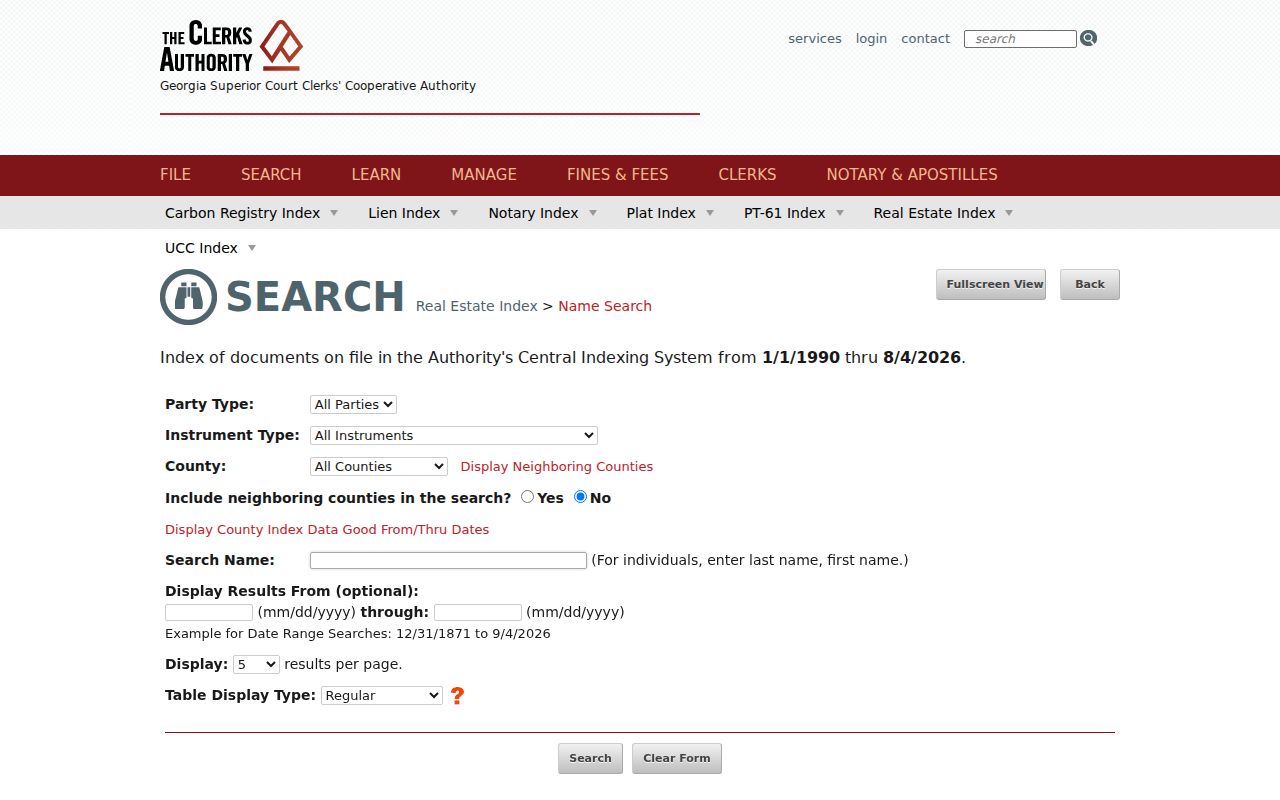
The deed index is a bridge, not the destination. A certified copy or a full title examination may still be needed before anyone relies on the result.
Clayton County Ownership Has Two Clocks
Georgia sets its assessment date at January 1. That single date creates two clocks for ownership in Clayton County. The tax roll may still show last year's owner of record. This can persist well after a sale closes. The county's Mapping Department publishes a useful benchmark. Ownership and map books are updated within four months of deed recording. That timing applies to the books as a whole, though. Any single property card online can lag behind it.
So date every answer you rely on. Pin down three things when you can. Get the recorded deed date, the assessor or map update date, and the tax year. A freshly recorded deed can outrun the tax roll. A deed index can lack an image or final cross-reference even later.
Clayton County Entity Owners
An LLC on a deed deserves one more lookup. Search the exact legal name in the Georgia Corporations Division. The result can show a control number, status, registered agent, and officer data. A registered-agent address is not the parcel's situs. It also stops short of beneficial owners. Search both the trust wording and each trustee named in the deed. Trusts are often indexed under trustee names. Describe the result as the entity or trustee named in the public record, not the person who ultimately benefits.
Clayton County Estate Owners
A deceased owner may lead to Clayton Probate Court. Its online estate search can connect the name with a will, letters, year's support, or another estate filing. Such papers explain why an executor or administrator signed a deed. The deed still remains the transfer evidence. There is an offline route as well. The court takes copy requests and lists estate contact at 770-477-3299. Include the decedent name and case details. Vital records carry their own eligibility and identity limits, so an estate search is not open access to a death certificate.
Watch Clayton County Property Filings
Georgia's Filing Activity Notification System, called FANS, alerts registered users when new deed, lien, plat, UCC, or personal-property filings match their chosen criteria. It only looks forward. It cannot catch a filing made before signup or block one from being recorded. See the official FANS service.
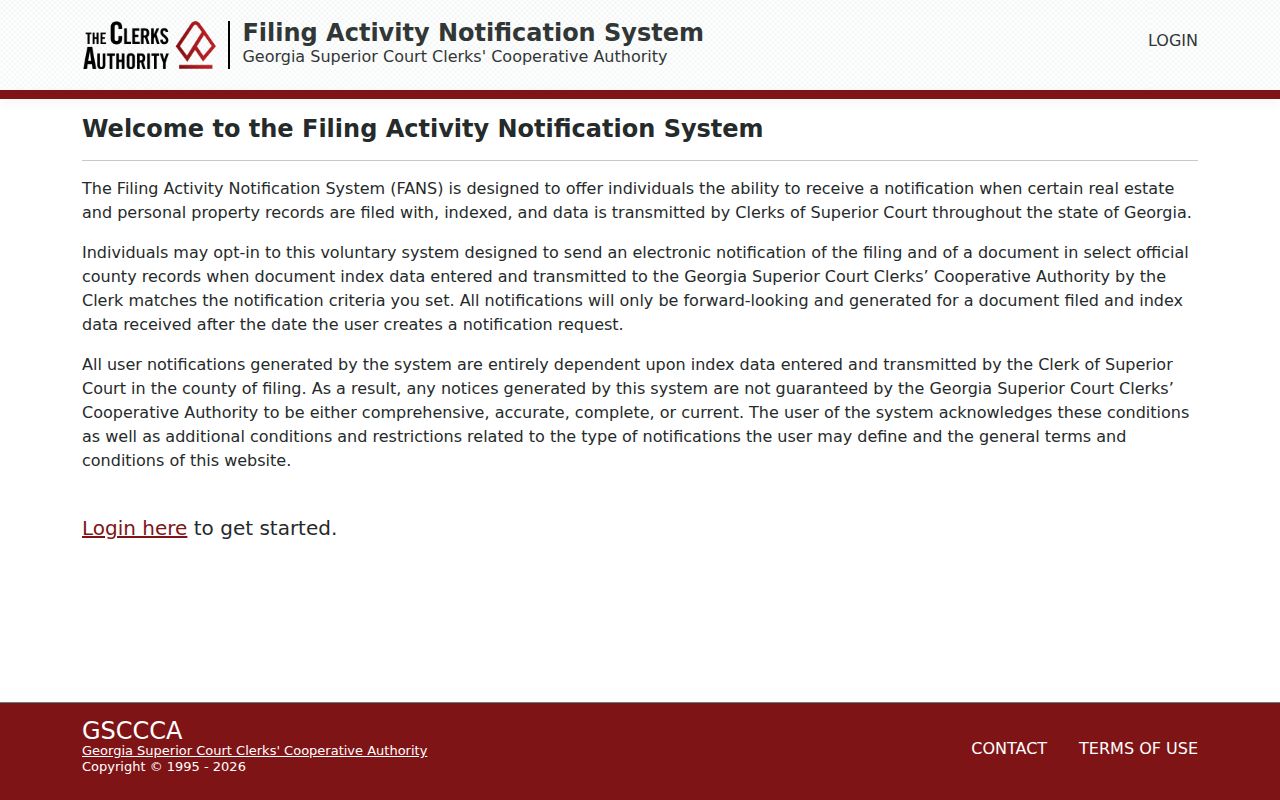
Treat any alert as a starting point, not a verdict. Pull the county filing behind it and read the instrument, the parties, the date, the image, the legal description, and the parcel number before drawing conclusions about Clayton County property records.
Offline Clayton County Owner Research
When the assessor portal is not an option, the Tax Assessor still answers questions by phone at 770-477-3285, and walk-in help waits at the P.K. Dixon Annex 3, fourth floor, 121 South McDonough Street in Jonesboro. For deed records, reach the Clerk's Real Estate Division at 770-477-3395 or visit the Harold R. Banke Justice Center, 9151 Tara Boulevard. The Clerk also supports eCertification for electronic copies. A Georgia Open Records Act request works for a record that never posted online. Name the address, the PIN, the record type, the date range, and the format you want. The agency has no duty to build new analysis for you. Ownership research reaching back decades may lead to deed books, microfilm, or the Georgia Archives in Morrow.
Clayton County Owner Deed Access
The Clayton Clerk describes its real-estate search as covering 1985 to the present. The system routes users into GSCCCA for deed records. Index data and search forms can be reachable even when a particular image is not. eCertification runs around the clock, and the Clerk's 2025 fee schedule prices certified copies at $2.50 for the first page plus $0.50 for each added page. Confirm current fees before you order anything. Ownership work before 1985 takes a different path. Local deed books, microfilm, or the Georgia Archives in Morrow hold the older deed records. That route suits a deep parcel history. But a who-owns question should always begin with the newest indexed transfer.
Limits of Clayton Owner Lookups
A web answer to who owns this property has hard limits. It cannot establish market value. It cannot establish clear title, beneficial ownership, tax clearance, or boundary location. It cannot confirm the absence of liens. The tax roll can lag behind a transfer. A recorded deed can be corrected later, or followed by another instrument entirely. Restricted or unindexed material may be missing too. So weigh any Clayton County property records answer with care.
Lawful use. Use Clayton County owner records for lawful property research, due diligence, estate work, and civic review, never to stalk, harass, or harm anyone.
Georgia Safe at Home and VoteSafe shield addresses for eligible participants. Neither program is an everyday opt-out. For detail on the current owner of record, see the Clayton County current owner guide.