
Clayton County Property Value Types
The Clayton County public access system bundles four lookups in one place: real-property, advanced, sales, and map searches. Each result carries a label. Always pair the value with its year. The county assessment file confirms the core fields, including parcel, tax year, transfer date, owner of record, fair market value, and property class, though the export may not mirror every field on a live property card.
| Value Type | Meaning | Official Record |
|---|---|---|
| Fair market value | The assessor's estimate of full value for the year | Assessor record |
| Assessed value | Generally 40 percent of FMV for Georgia real property | Assessment record |
| Taxable value | Assessed value after exemptions | Assessment and tax records |
| Last sale price | Consideration tied to a dated transfer | Deed, PT-61, or sales search |
Georgia uses a forty-percent rule. Real property is assessed at 40 percent of fair market value unless another statutory treatment applies. Exemptions then reduce taxable value, while the sale price belongs to a separate transaction and date.
Clayton's Forty-Percent Level
Start with fair market value. Multiply it by 40 percent. Subtract exemptions, and what remains is the taxable value that millage applies to. The formula keeps FMV, assessed value, and taxable value distinct. That separation is the key to reading Clayton County property records without drifting into a tax-bill walkthrough.
An exemption does not change market value. It only changes the amount exposed to tax under current rules. For application fields and required documents, the Clayton homestead form is the official source.
Clayton Values Change Annually
Clayton County reassesses real property every year, with each value dated January 1. Georgia sets no single statewide revaluation schedule. Instead, the county relies on its own review, on property facts, and on what the market shows. A number from last year can mislead you. Always pull the current assessment before quoting any figure.
The January 1 date matters for ownership too. A deed recorded after that day may name a new owner in the clerk's index while the tax roll still lists the January 1 owner of record. Match the year, the transfer date, and the deed record you are reading.
Look Up Clayton County Values
Begin with the physical address. That lookup leads you to the parcel, and from there the parcel number, or PIN, is the better tool for matching records across county systems, since Clayton PINs may include letters, leading zeros, and an internal space.
- Search the assessor by address and confirm the situs and PIN.
- Record FMV, assessed value, taxable value if shown, class, and tax year.
- Use the sales route or recorded deed source for a dated transfer amount.
- Compare like years and value types, noting parcel or class changes.
- Fair market value
- The assessor's full-value estimate for the year.
- Assessed value
- FMV after the statutory assessment level.
- Assessment ratio
- The percentage used to convert FMV.
- Sale consideration
- The amount tied to a recorded transfer when supplied.
- Reassessment
- A new review of value for an assessment year.
Clayton Sale Price Has Context
The GSCCCA real-property program covers deed, PT-61, sale-price, map, lien, and plat services. These sit in one place. A recorded sale amount is one data point, not a standing truth. It reflects a single transaction under its own conditions. One bona fide arm's-length sale can set the maximum allowable FMV for the year that follows. That is why context matters so much. Before treating any transfer as an open-market comparison, verify the instrument, the parties, the parcel, and the circumstances around it.
Clayton Value History Needs Labels
A string of FMV rows tells you what the county record did, not why. Plenty of forces can move it. A parcel split can shift a value. So can a class change, new construction, corrected data, or a broad review. Compare the PIN and the property facts from year to year before drawing conclusions. The official payment-history sample for PIN 13187C A030 lists payment years, dates, types, and amounts. Those figures are tax facts rather than market prices.
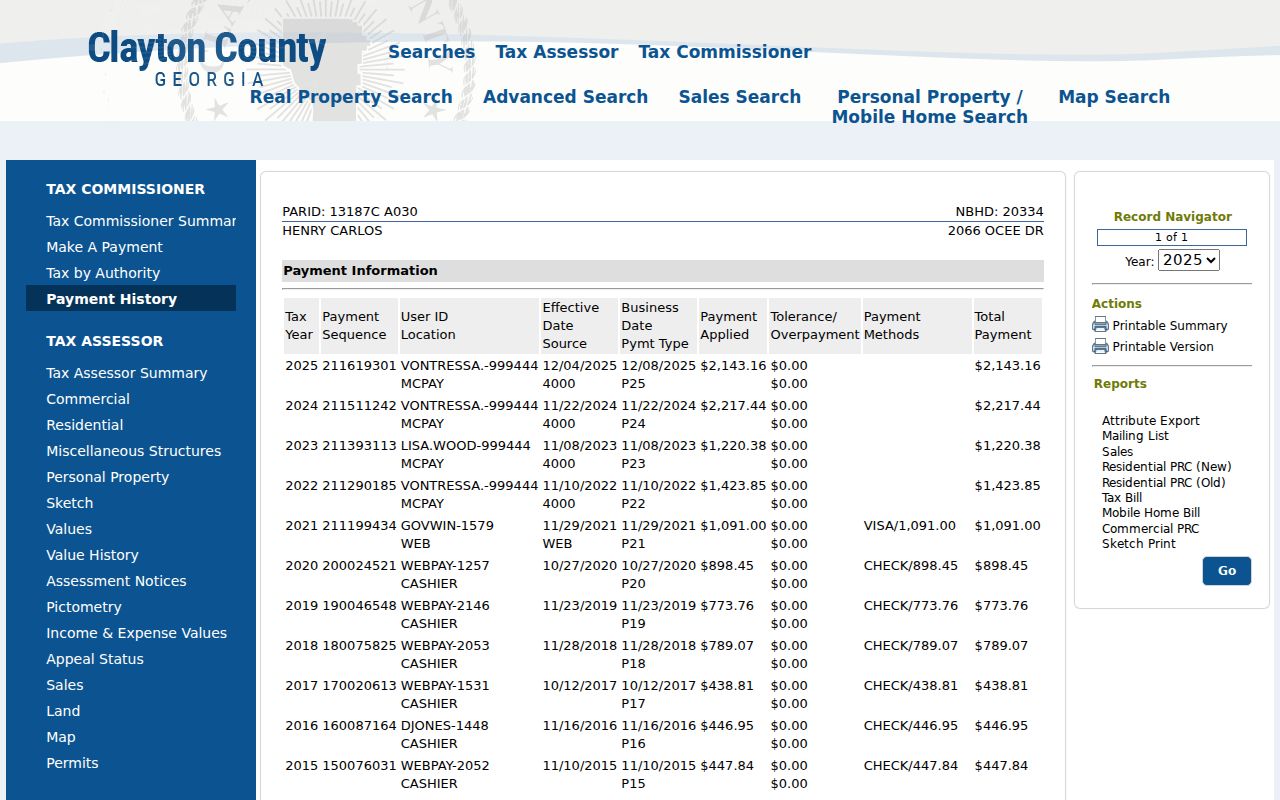
Dated rows in the property records supply tax context, but they never state what the parcel would sell for.
Tax-Sale Bids Are Not Value
Clayton County tax-sale lists carry a parcel, its location, the delinquent years, and a cry-out bid. They also show an FMV figure. Treat the cry-out bid with care. It reflects the sale process only. It is not an appraisal, fair market value, or proof of who holds title today.
Lists shift often, too. Payment, redemption, postponement, or transfer can remove a parcel before the auction ever starts. Before relying on any number, recheck the assessor and the deed index.
Clayton Value Access Channels
The Tax Assessor's office sits at P.K. Dixon Annex 3 in Jonesboro, and the listed number is 770-477-3285. Public access to the data can go down at times. When it does, ask the staff for help. Request an existing parcel card, digest row, or assessment record.
For bulk data, submit a request through the county Open Records portal. Be specific. Give the PIN, the year, the fields you need, and the format you want. Georgia law does not obligate the county to build a custom analysis. Keep that in mind.
Clayton Sale and FMV Differ
A recent sale can shape an assessment. But it does not freeze every later FMV at that same number. The county notice sets a one-year limit for a bona fide sale. It must qualify as an arm's-length transfer within that window. Some sales need extra context. Related-party, partial-interest, corrective, and special transfers rarely speak plainly on their own.
So use the sales search as a lead, not the verdict. The recorded instrument is the real source. Pull the document date, the recording date, any consideration shown, and the parcel identity before comparing anything. Skip the dates and you can pair numbers that never described the same moment in time.
Clayton Assessment Notices Date Value
An annual assessment notice does two things. It fixes a valuation date. It also opens a window for the owner of record to challenge the assessment. The 2026 Clayton County notice was mailed June 30. August 14 was the last appeal day. Those dates belong to that notice alone.
They are year-specific facts, not a standing calendar.
For value work, the notice tells you which value was under review. Record the notice year, the FMV, the assessed amount, and any sale date alongside it. The appeal procedure itself belongs with the property-tax topic. Before counting on a deadline, recheck the current notice page.
Clayton Exemptions Change Taxable Value
Exemptions shape the taxable side of a Clayton County tax bill. A homestead exemption trims taxable value while leaving fair market value untouched. Two Clayton County parcels can therefore carry nearly identical market estimates yet land on very different tax roll figures. That gap alone is not evidence of an assessor mistake. When comparing parcels, work from each parcel number's official exemption record for the right year. Categories and proof requirements shift over time. Guessing eligibility from an owner of record's age, an address, or a neighboring parcel is a fast way to misread the assessor's math.
What Clayton Property Value Omits
An assessed value exists to drive the property-tax system, nothing more. It is not an appraisal. It is also not a promise of what a parcel will sell for. A sale price pulled from deed records is simply history, while fair market value on the tax roll is the assessor's estimate for one stated year, never an offer.
Questions about a tax bill, an exemption, or an appeal belong with the Clayton County property tax records material. For a live transaction, only a qualified appraisal can settle what a public field cannot.
Value versus price. Clayton County assessed value is for taxation. It is not a sale forecast, offer, survey, or independent appraisal.