
Inside Clayton County Tax Records
Two Clayton County offices divide the work. The Tax Assessor sets fair market value, assessed value, property class, and exemptions. The Tax Commissioner then applies millage and credits. The office bills the tax, posts payments, and handles delinquent-tax material. Write the tax year beside every figure you copy. Values and bills shift from year to year.
| Record Field | Question Answered | Official Source |
|---|---|---|
| Fair market value | What full value the assessor assigned | Tax Assessor |
| Assessed value | What value is used before exemptions | Tax Assessor |
| Taxable value | What remains after exemptions | Assessment and tax records |
| Payment history | When and how much was paid | Tax Commissioner |
| Delinquent sale row | Listed years, bid, parcel, and FMV | Dated tax-sale list |
A tax figure is not a sale appraisal. Numbers can change after a review, an exemption adjustment, or a deed update. Before using any figure in a purchase review or an appeal, read the source label and date.
Clayton County's Forty Percent Rule
Georgia real property is generally assessed at 40 percent of fair market value. A different statutory treatment applies only in some cases. Clayton County presents the path as fair market value multiplied by 40 percent, minus exemptions. Millage is then applied to the result. Millage is simply the tax rate applied to taxable value.
That formula is why three labels get confused. Fair market value, assessed value, and taxable value are not interchangeable. An exemption trims taxable value, never the recorded sale price. Credits and separate millage components then shape the final bill. The Clayton County property value guide unpacks each value label in more depth.
Search Clayton County Property Tax
Begin at the Clayton real-property search. It offers basic real-property lookup, advanced search, sales search, and map search. Live labels can shift, so open with an address or owner name and note the PIN the system returns.
| Search Route | Documented Controls | Best Use |
|---|---|---|
| Basic | Owner, situs, parcel or PIN | Find the roll record |
| Advanced | Expanded live filters | Narrow results |
| Sales | Transfer filters | Compare sales |
| Payment result | PIN, year, date, type, amount | Check posted history |
The portal goes down for maintenance at times. If it is unavailable, call the Assessor for value data or the Tax Commissioner for bill data. A focused Open Records Act request can also seek a digest export or transaction file that is not posted online.
Trace a Clayton County Tax Bill
Start from the situs address, meaning where the parcel sits. The system returns a PIN. Use that exact key to keep the assessment record and the payment record tied to the same land.
- Search the county real-property page by situs address or owner.
- Copy the PIN exactly, including letters, spaces, and leading zeros.
- Open the payment view and select the correct tax year.
- Compare value, exemption, payment, and balance fields.
- Check a delinquent claim against the latest official list.
- Assessed value
- The statutory portion of fair market value.
- Millage
- The rate applied to taxable value.
- Homestead exemption
- Qualified relief for an eligible home.
- Tax lien
- A public claim tied to unpaid tax.
Clayton Payment History by PIN
The county's payment screen is illustrated with PIN 13187C A030. It shows history for 2012 through 2025. Each row lists tax year, payment date, payment type, and amount. That sample demonstrates the field types, not the current status of another parcel. See the layout on the official sample payment page.
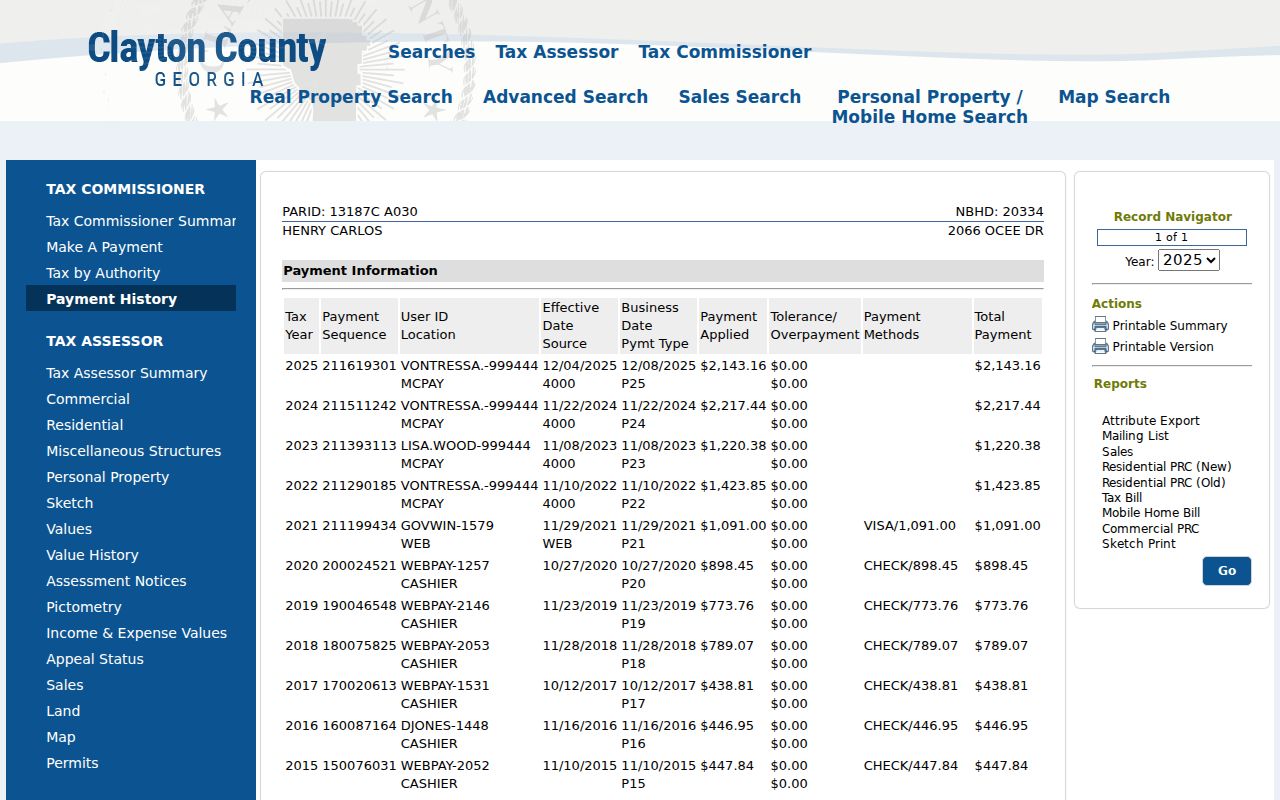
Year-by-year rows can confirm a payment posted. The Tax Commissioner remains the source for a present balance.
January First Controls Clayton Tax
The owner on January 1 generally stays the taxpayer of record for that tax year. Even if a closing happens later. Private closing papers may divide the costs. They do not rewrite the annual county record by sale date.
So the deed index can name a new grantee. But the tax roll still reflects the January 1 owner. The Mapping Department updates ownership and map books within four months of deed recording. That is a maintenance practice, not a guarantee. Compare the deed date, the tax year, and the map date before drawing conclusions.
Clayton County Homestead Proof
The homestead form asks for parcel ID, owner, address, purchase facts, prior address, and any other exemption claims. Instructions require state ID, a current voter card matching the home, and vehicles titled to the applicant and registered in Clayton County. Other proof may be reviewed. Applications generally run January 1 through April 1. Use the current Clayton homestead form. The form warns that email submission is not encrypted, so send only what the official process requires.
Clayton Delinquency and Tax Sales
The official 2025 sale list showed the date. It gave parcel and name, location, delinquent years, cry-out bid, and fair market value. A dated row proves nothing about current status. Redemption, payment, postponement, or a later transfer can change the facts. Check the current tax account and deed index. When asking the Tax Commissioner to confirm status, keep the PDF date and PIN handy.
Clayton Sales Versus Assessments
A sale field and an assessment field serve different purposes. The county's sales-search route helps locate transfer-oriented records. The assessor's annual fair market value supports taxation. Georgia law lets a bona fide arm's-length sale establish the maximum allowable fair market value for one year after the transaction. That rule does not make every listed transfer an open-market sale. It also does not turn the tax card into an appraisal.
When a sale looks relevant, compare its date and parties against the recorded deed. Then check the assessment year. Is it the year of sale or the next annual cycle? Family transfers, estate instruments, entity transfers, corrective deeds, and other non-market events can sit in record history. They may not show an ordinary purchase price. Keep the transfer source, the deed type, and the assessment year together.
Request Clayton Tax Data
Clayton County offers another access channel. The county can return assessment data as a file. Each row carries sequence, parcel, tax year, transfer date, owner name, mailing address, city, state, ZIP, fair market value, and property class. That suits a defined group of parcels. Check any raw row against the live account before relying on it.
Ask for the file, not a custom report. A good request names the tax years, the parcel range or file, the fields you need, and your preferred electronic format. Georgia permits reasonable search, retrieval, and production charges under statutory rules. Request inspection first when unsure.
Contest a Clayton County Assessment
Each annual assessment notice opens a 45-day window. A written appeal must land within that period. Clayton's 2026 appeal cycle mailed notices June 30 and closed August 14. Treat those dates as specific to that year. Appeal routes include the Board of Equalization, a hearing officer, arbitration, and Superior Court.
The hearing-officer track needs non-homestead property over $500,000. Arbitration demands a certified appraisal and can shift costs, while Superior Court offers a jury trial plus filing fees.
Appeal window. File within 45 days of the current notice date and confirm that year's deadline before filing.
The Board of Equalization page gives current steps.
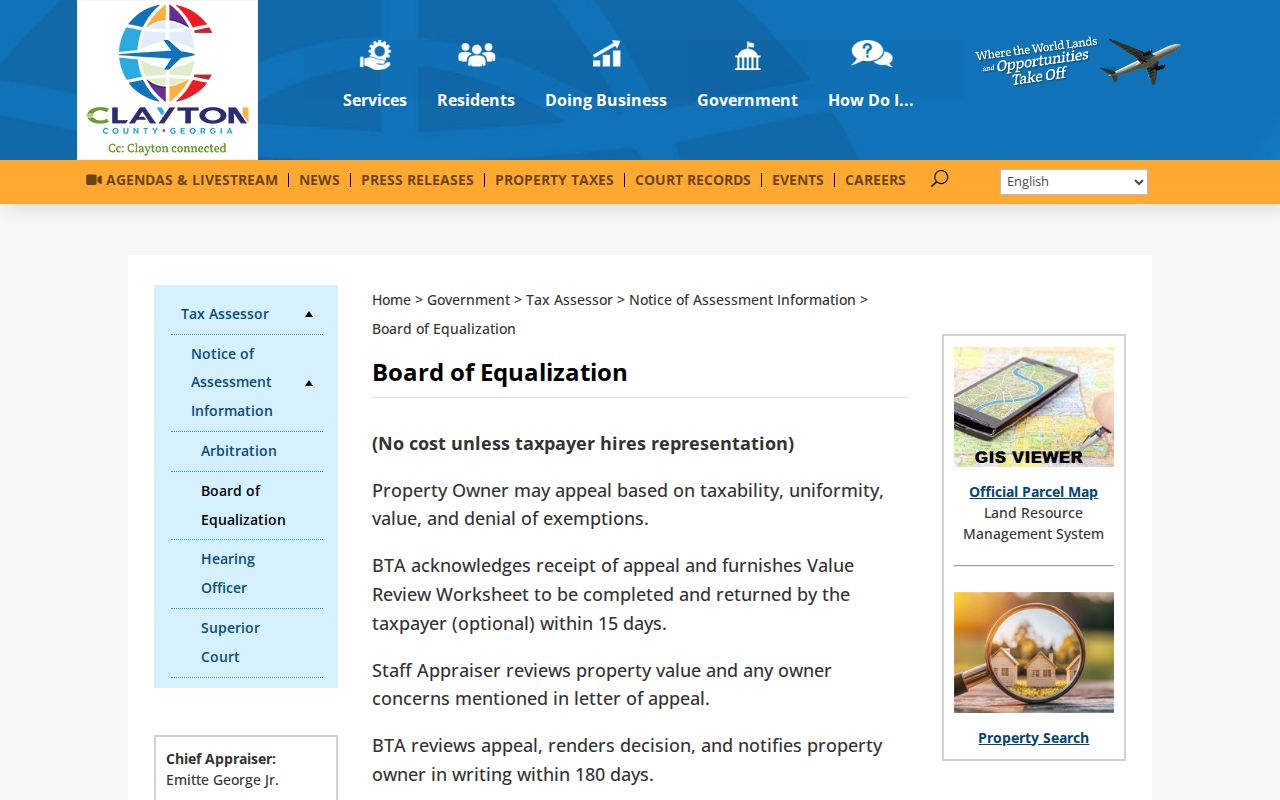
The official page is the place to verify live forms, filing methods, and dates.
Offline Clayton County Tax Access
The Tax Assessor sits on the fourth floor of the P.K. Dixon Annex 3, 121 South McDonough Street in Jonesboro. That office takes calls at 770-477-3285. The Tax Commissioner works from the second floor of the same building and lists 770-477-3311 for property tax. Hours run 8 a.m. to 5 p.m. weekdays.
For an unposted record, bring the PIN, tax year, record type, and format you want. Request inspection, a copy, or an existing export. Georgia's Open Records Act never requires new analysis.