
How to Search Clayton County Property Records
Three linked systems hold Clayton County property records. The Tax Assessor is the natural starting point when you have an address. Copy the parcel PIN and owner name exactly. Then test the recorded deed through the Clerk of Superior Court and the GSCCCA index. The Tax Commissioner adds tax bills and payment history. The county map shows the parcel's setting. No single screen proves title, a legal boundary, or every debt on the land, so use each source for the question it answers.
- Normalize the street number, street name, suffix, city label, and ZIP.
- Search the assessor's basic route and capture the PIN, situs address, mailing address, owner field, value fields, and tax year.
- Search that owner as both grantee and grantor in the GSCCCA Real Estate Index.
- Carry the exact PIN into tax payment and map searches.
- Ask the custodian for a copy or older book when the web route stops.
Need help with a stubborn query? The longer walkthrough on Clayton County property search methods covers partial-address retries and shows how to preserve a PIN's spaces and letters.
Clayton County Property Records Offices
Each office plays a distinct role. The assessor identifies and values parcels, the Tax Commissioner bills and collects, and the Clerk records instruments that affect land. Always note which office issued a result.
Clerk of Superior Court, Real Estate Division
Harold R. Banke Justice Center
9151 Tara Boulevard, Jonesboro, GA 30236
770-477-3395
Clayton County Tax Assessor
P.K. Dixon Annex 3, fourth floor
121 South McDonough Street, Jonesboro, GA 30236
770-477-3285
Clayton County Tax Commissioner
P.K. Dixon Annex 3, second floor
121 South McDonough Street, Jonesboro, GA 30236
770-477-3311
Clayton County Property Records Begin With a Precise PIN
Clayton parcel identifiers look like 13187C A030, 05112A B009, and 06165D A025. Letters and an internal space are part of the format. The county publishes no official segment-by-segment key. Copy the PIN exactly as shown. Never recast it as a plain number. That exact value links the assessor record to the tax and map systems even when a postal city or ZIP label causes confusion.
Types of Clayton County Property Records
Clayton sources cover ownership, value, payment, maps, and deeds. Read the date and custodian with every result, because similar-looking fields can measure different things.
| Record set | What it can document | Official keeper | Access route |
|---|---|---|---|
| Deeds and security deeds | Transfers and recorded loan instruments | Clerk of Superior Court | GSCCCA index, clerk copies |
| Assessment roll | Owner field, situs, mailing address, FMV, class | Tax Assessor | Basic, advanced, sales, and data routes |
| Tax account | Bills, payments, exemptions, tax-sale context | Tax Commissioner | County public access |
| Parcel map | Mapped polygon, nearby parcels, reference layers | Assessor Mapping and GIS | Map Search and ArcGIS |
| Plats and liens | Subdivision filings and recorded claims | Clerk / GSCCCA | Plat and lien search forms |
Clayton County Assessor Search Modes and Fields
The assessor's landing page offers four search routes. Basic Real Property, Advanced, Sales, and Map Search are the choices. Fields vary by interface, so the table separates documented controls from those that depend on the current screen.
| Mode or field | Use | Research caution |
|---|---|---|
| Owner or name | Find the tax-roll name and test entity spelling | Exact current labels are portal-controlled |
| Property or situs address | Start from the physical location | Do not confuse it with mailing address |
| Parcel or PIN | Move between card and map | Preserve spaces and leading zeros |
| Sales search | Review sale or transfer-oriented entries | Current filter list was not fully captured |
| Map parcel ID | Zoom to a known parcel | Map lines are not a survey |
The county cautions that assessment data is informational and not warranted as error-free. Record the tax year and retrieval date too.
Clayton County Deeds Through the Clerk and GSCCCA
Clayton County deed research runs through two doors. The Clerk's real-estate search covers 1985 to current. GSCCCA adds separate name, book/page, lien, plat, and property forms. Begin a name search broadly, with Clayton selected and no narrow instrument filter. Then test the party as grantee and as grantor. The direct book/page form requires both numbers. Party names may come from captions, opening statements, or signatures, so try initials, name order, entity suffixes, trustee wording, and former names when the first query misses. The detailed Clayton County deed records guide follows this index-to-copy path.
Clayton County Values and the January 1 Tax Clock
Georgia sets a simple baseline. Real property is generally assessed at 40 percent of fair market value. Another statutory treatment may apply instead. Clayton sources describe the path plainly: fair market value times 40 percent, less exemptions, then the millage calculation. That assessed figure is not an appraisal. It will not predict a sale price either. The January 1 rule can also surprise buyers. Whoever holds title on January 1 generally remains responsible for that tax year, even after a later closing. Map and ownership books update within four months of recording. Treat that timing as office practice. It is not proof that every online card has caught up.
Clayton County Parcel Maps, Buffers, and Nearby Land
The Map Search is not a static picture. The Tax Assessor's parcel-ID lookup and identify tools sit beside measurement, print, and export options. Selection management covers freehand, point, box, polygon, and line drawing. The buffer tool is the standout. It accepts feet or meters. It works from center points or polygons. It slides from zero to 1000 with a default of 100. Buffers can flag candidate parcels around a subject lot. They still cannot settle a legal boundary. A recorded plat, deed description, and professional survey answer that question.
Clayton County Plats, Liens, and Related Filings
GSCCCA's plat form searches by county, name, Section or GMD, district, land lot, date range, and display controls. Its lien form works like the real-estate name search. Recorded material spans warranty, quitclaim, and security deeds. Assignments, cancellations, releases, easements, rights-of-way, liens, lis pendens, plats, and corrective instruments round out the index.
Core record terms
Grantor conveys the interest. Grantee receives it. A parcel is the county's mapped tax unit, a plat depicts lots or a subdivision, and an assessment supports taxation without proving title.
Older Clayton County Property Records in Morrow
Clayton County dates to 1858, well before any electronic index covered Georgia. That age matters for deed research. The Georgia Archives, located in Morrow since 2003, holds a County Records Microfilm Index, finding aids, and Virtual Vault resources. Its death-record guide points to Clayton material from 1875. So older land work often leaves the 1985-to-current online route. It turns to deed books, microfilm, or archive finding aids instead.
Timing explains a lot here. GSCCCA's statewide real-property program went live in 1999, and historical deed reindexing started in 2002. Availability therefore varies by era. These dates are milestones, not promises. Not every old deed image has been digitized. A parcel number in a modern index may have no counterpart in an 1800s deed book. The Georgia Archives catalog and research services explain how to identify a collection. Then you can request a specific reel or volume.
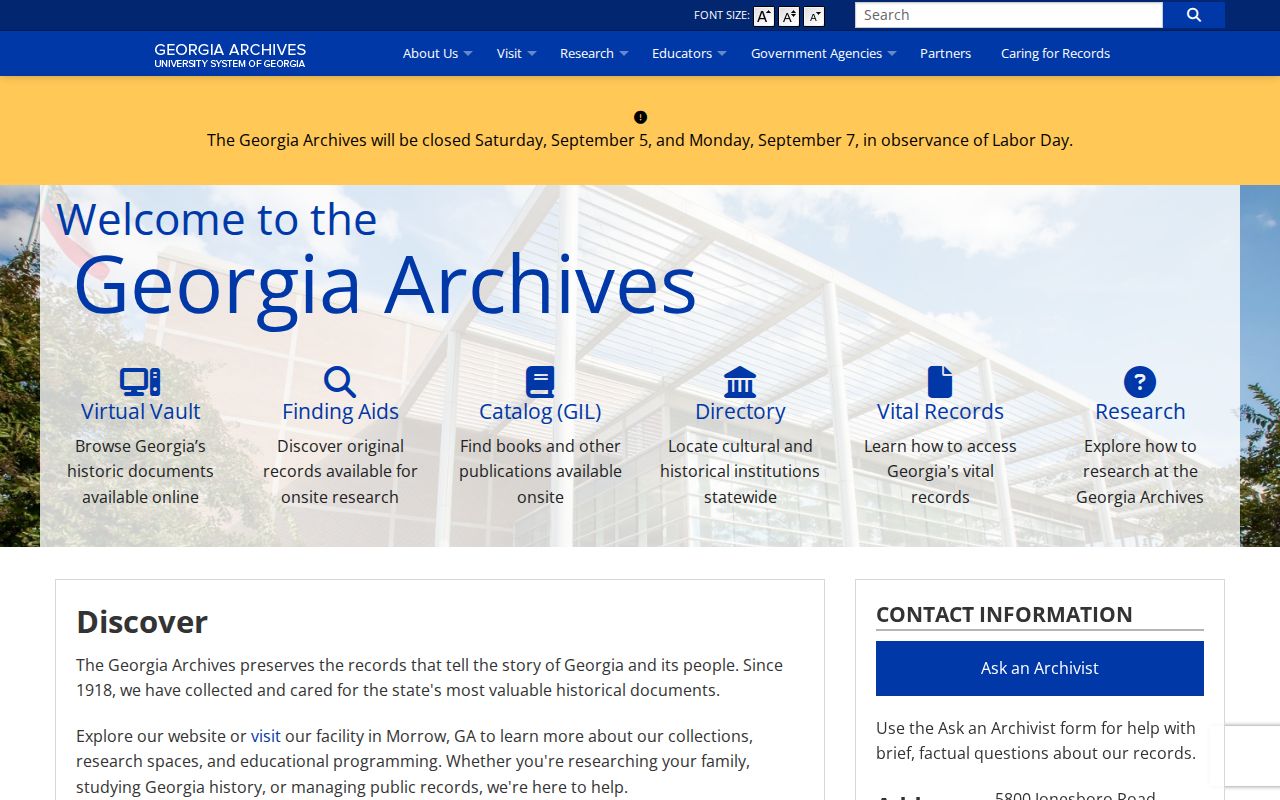
The image above is an orientation view, not a Clayton County deed card. The book, reel, or record itself remains the evidence.
Clayton County Probate and an Interrupted Ownership Chain
A deed chain rarely moves in a straight line. Owners die, and the parcel passes through an estate before any sale. Clayton Probate Court keeps wills, estate cases, letters, year's support, and guardianships. Related filings can bridge that gap. Its online estate route may connect a deceased owner of record to an estate file. But probate does not replace the deed. The instrument that actually changes the land record comes later. A complete chain needs both documents.
Vital records have their own rules. Georgia birth records are generally restricted for 100 years. Older death and related records follow separate transfer and eligibility requirements. A death certificate is not an open owner-search tool. Match the record type and access path to the property question at hand.
Clayton County Filing Alerts and Deed-Fraud Caution
GSCCCA's Filing Activity Notification System sends notices when matching index data arrives from participating clerks. That includes deed, lien, plat, and UCC filings. For a Clayton County owner of record, that offers early warning of unexpected filings. It is not a title freeze, though. It cannot guarantee that every name variation will match. Owners should inspect each notice and verify the filing with the Clerk.
Requesting Clayton County Property Records Offline
Portals go down, images go missing, and sometimes only a database export will do. In those cases, contact the office that keeps the source record. The Clerk offers eCertification for court and real-estate records and accepts real-estate e-filing. County database requests go through the county Open Records portal. Some departments keep separate routes.
The Georgia Open Records Act generally directs a request to the custodian. It sets a three-business-day response rule where it applies. State guidance permits reasonable search, retrieval, and production charges. It includes a 15-minute labor exclusion. Ordinary paper copies are generally capped at $0.25 per page, subject to law and exemptions. Frame the request tightly. Ask for the record by office, date range, PIN, instrument number, or book and page, and ambiguity drops fast.
Limits of Clayton County Property Records
Public records are not perfect. A tax roll can carry a stale name. An index can hold a transcription error. Exempt details may be withheld. A GIS map can lag behind a recorded deed. Safe at Home and VoteSafe protect qualifying participants in defined settings. They are not routine opt-out tools. County sources also change without notice. The public-access landing page has carried maintenance messages before.
Keep a small audit trail as you search. Note the portal. Note the search terms and the tax year. Note the document date, the recording date, and the date you checked. For a purchase, estate dispute, boundary question, or contested lien, consult the proper professional and obtain the official document.